
Slow progression wins the race

Updated: Apr 6
The athlete who builds gradually almost always outlasts the one who builds fast. Here's why that isn't obvious and why it should be.
Everyone remembers the hare. Fast out of the blocks, full of confidence, completely certain that speed alone is enough. What we forget is that the hare's problem wasn't laziness; it was the assumption that more, faster, sooner is always better. In sport and in training, that assumption is one of the most expensive mistakes you can make.
The principle of progressive overload has been in exercise science for decades. It states, simply, that the body adapts to stress but only when that stress is applied in the right amount, at the right time, with enough recovery to allow adaptation to occur. Too little and nothing changes. Too much too soon and the system breaks down before it builds up. The window of productive stress is narrower than most people assume.
The body doesn't adapt to the training you do. It adapts to the training it can absorb.
Research consistently supports a 10% weekly load progression ceiling as a general guideline though the exact number is less important than the principle behind it. A study published in the British Journal of Sports Medicine found that athletes who increased their training load rapidly faced significantly higher injury rates compared to those who progressed gradually. The tissue adaptations tendons, ligaments, bone lag behind cardiovascular fitness by weeks. You can feel ready when you aren't structurally ready.
What makes this even more powerful today is that we can actually see it happening in real time. GPS and load monitoring tools can detect when an athlete's recent training has outpaced their longer-term base often days before the body signals it through pain or fatigue. The data doesn't prevent injury on its own, but it gives coaches and players a window to act before the damage is done.
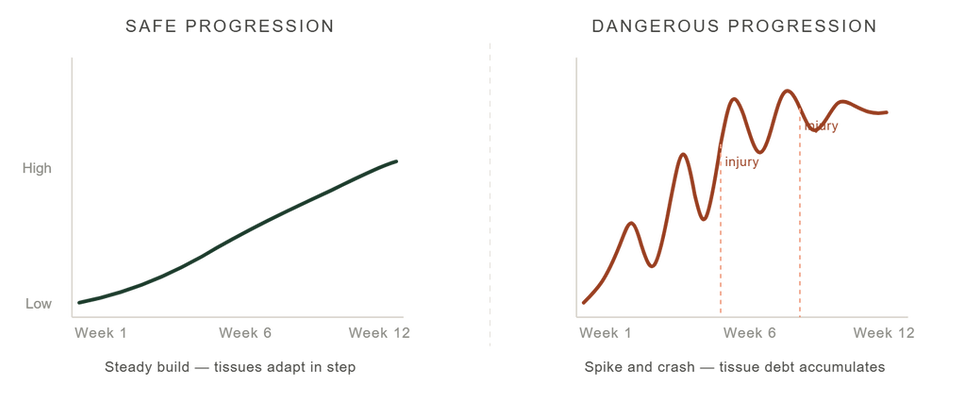
But this isn't just about avoiding injury. Slow progression produces a different kind of athlete. one whose physical base is dense, not just large. Tendons that have been loaded progressively over months are structurally different at the cellular level. Aerobic systems built gradually show better mitochondrial density. The athlete who has never skipped a step is harder to break, easier to peak, and more consistent across a long season.
Players can feel undertrained when they are, in fact, perfectly placed.
The hardest part of slow progression is that it feels wrong in the short term. Coaches feel pressure to load. Clubs want readiness now. Players can feel undertrained when they are, in fact, perfectly placed. The discipline isn't in doing more — it's in trusting the process when the calendar is pushing against you.
The turtle doesn't win because the hare falls asleep. The turtle wins because it never builds a debt it can't repay.

So the question worth sitting with: how do you actually design a progression that is slow enough to be safe, but still fast enough to produce results — week by week, block by block, across a full season?
KEY TAKEAWAYS
The body adapts to what it can absorb, not what you give it.
A 10% weekly load progression is a good guideline.
Acute:chronic workload ratio is your early warning system. GPS data is most powerfull but not the only way to do it.
Slow progression builds superior athletes. Trust the process.
The discipline is resisting the pressure to do more and wait for the compound effect.


